Opening Ceremony lays the foundation for cross-sector collaboration and breakthrough solutions.


10-14 JANUARY 2027 Abu Dhabi, UAE
EN
The Zayed Sustainability Prize Awards Ceremony celebrates 11 winners driving real-world impact across the categories of Health, Food, Energy, Water, Climate Action and Global High Schools.
The ADSW Summit sparks dynamic, inclusive discussions that drive the global sustainability agenda forward.
This Global South–focused gathering will convene policymakers, developers, financiers, and off-takers from the Global South and the UAE.
Blue Forum will focus on mobilizing $100 billion in water and ocean investment by 2030.
Read the latest thoughts and analysis on breakthrough solutions driving impact for a sustainable future
Explore reports and strategic insights from ADSW
Line of Sight Podcast brought to you by ADSW
Hear influential voices discuss global challenges and the solutions for a sustainable future
Subscribe to get the latest news, events and announcements
Open to all, the competition will accept submissions until November 16, 2025.
Get insights from crucial conversations throughout the global sustainability calendar
Watch virtual conversations with thought leaders and experts around the world
Find out why we convene the global sustainability community each year
See the sustainability experts helping guide ADSW's strategy
Read our story
Be part of a leading global sustainability platform
See the leaders from across sectors and around the world who have joined ADSW
A global leader in sustainability, Masdar has hosted ADSW since 2008

Hidden Currents: How Sovereign Wealth Funds Are Building Climate Resilience from Within
19 JUNE 2026
2773

By Enrico Soddu, Chief of Content, Senior Consultant, International Forum of Sovereign Wealth Funds (IFSWF)
In 2020, Dr Victoria Barbary, then-Director of Strategy at International Forum of Sovereign Wealth Funds (IFSWF), and Dr Elizabeth Harnett, then-Senior Consultant for the One Planet SWF Network (OPSWF), proposed surveying about 40 sovereign wealth funds on their climate change efforts. At the time, the world appeared quite different, as many countries grappled with the first pandemic seen in over a century, and the climate conversation was simply not news. Despite this backdrop at the time, 93% of survey respondents acknowledged considering climate change, but only 12% had a formal framework to address it. Just 23% had attempted to measure their carbon footprint. This gap between intention and means marks the start of this story, the slow construction of climate resilience from within institutions.
Six years and five subsequent editions later, the IFSWF–OPSWF Climate Change Survey has established itself as the only ongoing empirical record of how sovereign wealth funds incorporate climate considerations into their institutional practices.
The series and the survey design changed across the six years. Perhaps the most striking finding representing this evolution is that, in 2021, half of our respondents said that they were adopting climate integration as a value proposition: "the right thing to do." By 2022, risk and returns had overtaken values as the primary driver. By 2026, we had removed the value option from the questionnaire altogether as it was no longer relevant. For the first time, more respondents (74%) chose better long-term returns as the main reason for integrating climate, overtaking risk reduction (68%).
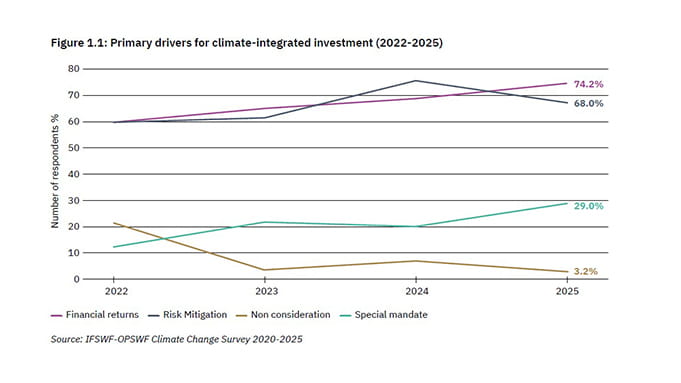
It is not simply a change in communications or perception. It is an institutional one. Climate moved from being in the sustainability team's briefing to the investment committee's essential due diligence tool. When returns lead the conversation, the chief investment officer (CIO) is in the room rather than the Risk and Compliance team. Climate has become a portfolio-resilience question, not a values one.
From attitudes to process
The early editions reflected sentiment in the survey design and the results; in the later ones, we started tracking the process. For example, carbon footprinting rose from a niche 23% to over half the sample. Contractual climate provisions with external managers quadrupled, from 12% in 2022 to 42% in 2026. Demand for specific climate metrics from managers doubled. ISSB-aligned reporting rose from 9% to 26%, perhaps due to a streamlining of reporting standards in the last two years.
Meanwhile, the most high-profile tool, engaging with portfolio companies on climate, fell from 59% to 36%. We don’t think it's because sovereign wealth funds stopped caring. More likely, climate scrutiny moved upstream into due diligence and manager selection before capital is deployed, making the work more structural and less performative.
What hasn't changed
Sovereign wealth funds’ desperate need for data quality. In every edition, it remains the top barrier. It peaked at 78% in 2022 and is now at 58%. OPSWF has worked to narrow that gap; its framework pushed members toward consistent reporting standards, and the survey itself has tracked the shift from ad hoc disclosure to ISSB-aligned reporting, which rose 17% between 2022 and 2026, as mentioned above. Despite six years of progress on governance, mandates, and reporting standards, sovereign wealth funds still struggle to measure what they most need to manage. That is not a problem for a single sovereign wealth fund with limited resources. It is a market infrastructure problem, and no single organization can fix it alone. And it remains the binding constraint on the resilience the sovereign wealth funds are trying to build.
The report itself
The 2020 pilot survey was an exploratory exercise, a snapshot of attitudes with no baseline for comparison. By 2026, we were running a five-chapter longitudinal study with net scores across 20 climate segments. At the same time, we are transparent about what our small sample can and cannot tell you. We name our biases before we publish our findings, a discipline that took time to build. How we arrived at those methodological choices, including the decision to adopt a net-score framework for compressing twenty climate segments into something an investment committee can actually use, and the visualization decisions that followed, is a story in its own right, which we published as part of our How We Work at IFSWF series.
What I noticed while analyzing the data during this six-year exercise is that perhaps unsurprisingly, as the political debate over climate has grown more divisive, sovereign wealth funds have become quieter. Still, they are now integrating climate considerations into contract terms, risk frameworks, and reporting standards. We called the 2026 edition Hidden Currents for a reason. The surface looks calm, but beneath the surface, sovereign wealth funds continue to build their infrastructure and processes.
Whether this framework has enough capital to meet the scale of the transition, and the adaptation finance and resilient infrastructure that the most exposed economies still need, is another question. But the institutional foundations are no longer improvised.
More Expert Insights
07 SEPTEMBER 2026
Retaining Value: Why Textile Circularity Requires National Systems
26 AUGUST 2026